
Every open specialty referral is a patient your health system has already earned. A physician in your network decided the patient needs a specialist, the patient agreed, and the order is in the system. What happens next decides whether that care, and the revenue attached to it, stays with you.
In most health systems, what happens next depends on capacity. Referral queues grow faster than access teams can work them, and patients who never hear back often find care elsewhere or delay it until it becomes more urgent and more expensive.
That makes referral management one of the most direct revenue levers a health system has. The demand is already there; the work is reaching those patients in time.
The value behind every open referral
A specialty referral is rarely a single visit. A GI referral can lead to a colonoscopy, pathology and follow-up care. A dermatology referral can lead to biopsies and procedures, and an orthopedic consult to imaging, surgery and rehab.
The first appointment opens the episode of care, and most of the revenue sits downstream of it. When the patient never schedules, or schedules somewhere else, the whole episode goes with them.
The scale is significant. Benchmark work from Endeavor Management's referral analytics practice estimates that 45% of referral revenue from employed primary care physicians leaves the network (BD Emerson, 2026). Many referrals never become appointments at all: in an analysis of 103,737 referral scheduling attempts at Duke, 34.8% resulted in a documented completed specialist visit (Patel et al., J Gen Intern Med, 2018).
Capacity decides how many referrals become care
The Duke data shows where referrals stall. 38.9% of scheduling attempts never received an appointment date. 6% of referred patients could not be reached, and 12% declined scheduling for reasons nobody recorded. Wait time mattered too: completed appointments had a mean wait of 20 days, incomplete ones 42.
Each of those gaps comes back to staff time. Reaching a patient takes several attempts, at hours that work for them. Confirming the referral is still needed, and gathering what the specialist needs to prioritize, takes a real conversation.
Access teams already work these lists hard. With thousands of open referrals, they reach whoever answers first, which is rarely the same as whoever needs care most. The list simply outgrows the hours available to work it.
Working the full list, in order of clinical need
Health systems using AI conversations for referral management can work every referral on the list, not only the ones a scheduler reaches first. The workflow looks like this:
- Reach every patient. Each patient on the list receives a call, with retries at different times of day, so reach no longer depends on who picks up the first time.
- Confirm the referral is still active. The conversation checks whether the patient still needs the appointment, has already been seen elsewhere, or faces barriers such as transportation.
- Screen with the specialty's own criteria. The specialty team defines the questions, such as symptoms or recent changes, that identify patients who should be seen sooner.
- Route each patient to the right next step. Urgent cases go to clinical staff for priority scheduling, routine cases move to scheduling, and referrals that no longer apply are closed.
- Return the results to the team's workflow. Outcomes are documented in the systems the team already uses, so everyone works from one updated list.
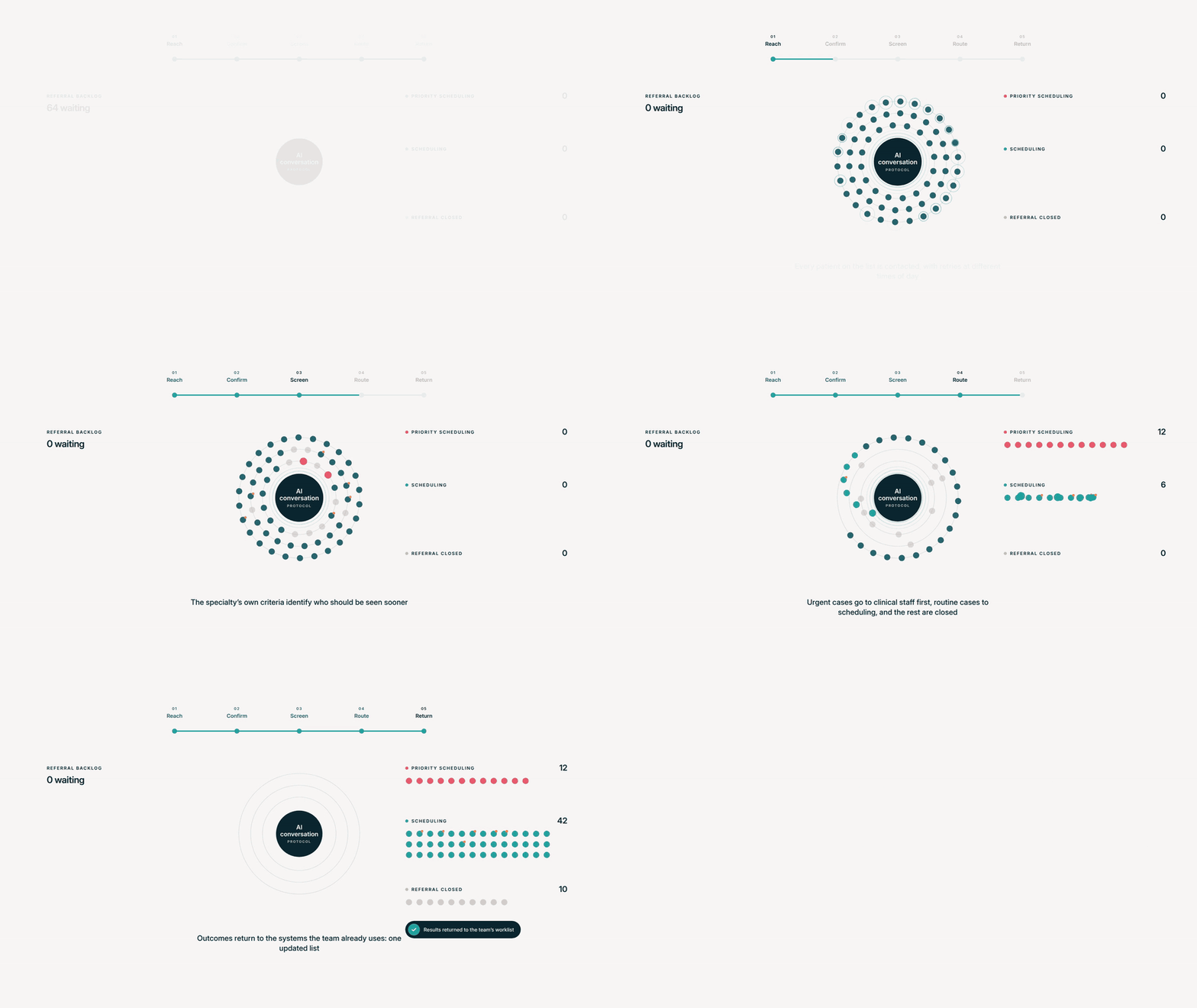
The team's role shifts from dialing through the list to acting on what it reveals. Schedulers and nurses spend their time on the patients who need a person, and the specialty sees its highest-acuity referrals first.
Because each conversation follows a protocol the clinical team approves, with escalation rules built in, the program is clinical-grade, scoped and measurable. That also makes it a project AI governance committees can evaluate and approve quickly.
Measuring referral management ROI clearly
With median hospital operating margins around 1.7% (Kaufman Hall National Hospital Flash Report, March 2026, compiled by BD Emerson), revenue from referrals the network has already generated is some of the least expensive growth available. Measuring the program against clear ROI metrics makes that value visible and measurable from the first month.
MetricWhat it shows about ROIPatients reached / open referralsHow much of the backlog is being workedReferral-to-appointment conversionHow much demand turns into scheduled careDays from referral to appointmentExposure to patients going elsewhereCompleted visits and downstream encountersRecaptured revenue, valued with the system's own contribution marginsReferrals closed as no longer neededA cleaner list and more accurate capacity planningStaff hours redirectedCapacity returned to the team for higher-acuity work
Set the baseline for the same specialty before go-live, then track these monthly. The downstream value per completed referral should come from the system's own finance data, which keeps the business case defensible in front of a capital committee.
Where to start: one specialty, one list
The fastest path is a single specialty with a large backlog and high downstream value. Derm or endo are strong candidates: long waitlists, clear clinical criteria for prioritization, and procedures that follow the first visit.
From there, the steps are concrete. The specialty team defines the screening questions and escalation rules, operations or finance agrees on the baseline and how recaptured value is counted, and the program launches on the existing list. A scoped program like this can go live in weeks, and the first numbers arrive as soon as the list starts moving.
Once the first specialty shows results, the same protocol structure extends to the next one, with the clinical criteria adapted for each service line.
Your backlog is a map of demand
Every open referral represents care a patient needs and revenue the network has already earned. Working the full list, in order of clinical need, turns that backlog into completed visits, recaptured episodes and a clearer picture of specialty capacity.
If you would like to estimate what your own referral backlog is worth, and how much of it your team could recapture this year, talk to our team.
Sources
- Patel MP, Schettini P, O'Leary CP, Bosworth HB, Anderson JB, Shah KP. Closing the Referral Loop: an Analysis of Primary Care Referrals to Specialists in a Large Health System. J Gen Intern Med. 2018;33(5):715-721.
- BD Emerson with Endeavor Management. Referral Leakage Statistics and Benchmarks, 2026. Includes the 45% employed-PCP benchmark and Kaufman Hall margin data.