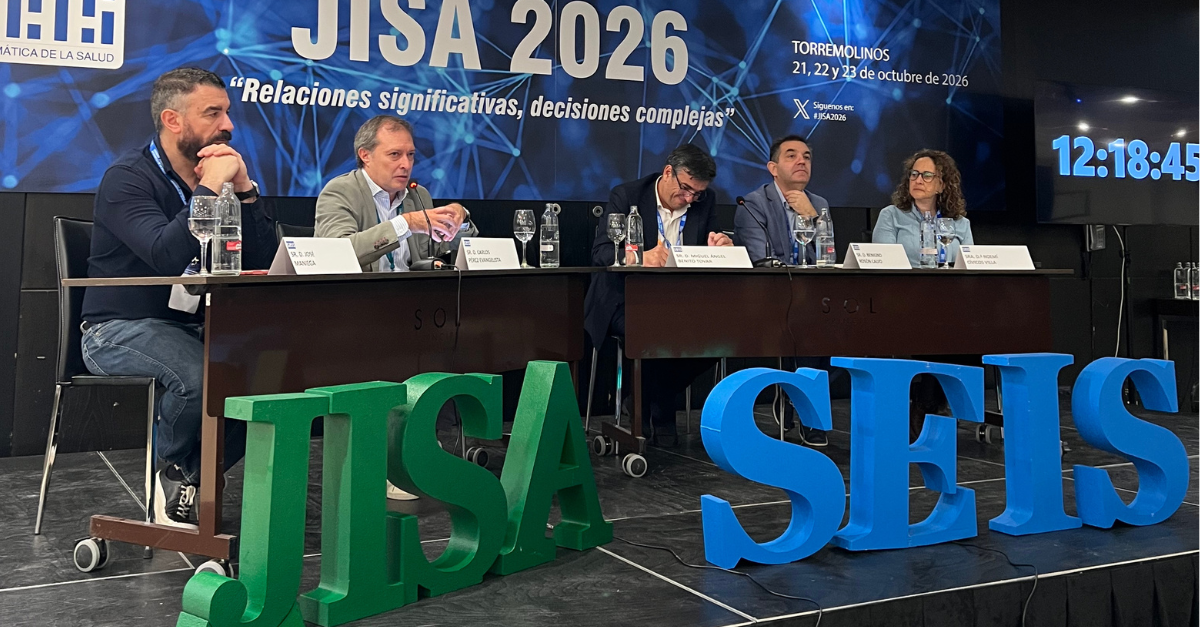
Artificial intelligence is already on the agenda of health services. The question now is a different one: what it takes for AI to move beyond pilot projects and become a stable tool in day-to-day care.
That was one of the central questions at the 33rd National Conference on Innovation and Health in Andalusia (JISA 2026), organized by the Spanish Health Informatics Society (SEIS) from October 21 to 23 in Málaga under the theme "Meaningful relationships, complex decisions." Three days that ended with a shared conclusion: adopting technology is not enough; it has to work for patients.
Tucuvi took part in the closing panel, and this article summarizes the main takeaways from the discussion.
What was discussed in the closing panel?
The "Next Steps" panel was moderated by Noemí Cívicos Villa, Director General of Digital Health and Information Systems for the National Health System (Spanish Ministry of Health), and brought together representatives from health administrations and industry:
- Benigno Rosón Calvo, Deputy Director General of Information Systems and Technologies at the Galician Health Service (SERGAS)
- Miguel Ángel Benito Tovar, Deputy Director of Transformation, Innovation and Digital Health at the Balearic Islands Health Service (IB-SALUT)
- José Antonio Rodríguez Maniega, Senior Director of Oracle Health for Southern Europe and Latin America
- Carlos Pérez Evangelista, Sales Director Europe at Tucuvi
Despite their different perspectives, participants agreed on the essentials: putting patients at the center, sharing data securely and making systems understand each other through standards and interoperability. From there, the discussion produced three key ideas.
Why should patients take on a bigger role?
The first conclusion was that the digital transformation of the health system cannot be designed only from within healthcare organizations. Patients need tools that allow them to communicate with the system in an agile, continuous way, not only at the time of an appointment.
When that communication is in place, care teams have timely information to act on, and patients move from being passive recipients of care to taking part in it.
How do we move from pilot to real adoption?
The second message was clear: technologies that already show benefits for patients and professionals need to be deployed at scale. Pilots are necessary to validate a solution, but the value for the health system comes when that solution becomes a stable part of care processes.
An example was cited during the conference itself: Antonio Sanz Cabello, First Vice President and Regional Minister of the Presidency, Health and Emergencies of the Government of Andalusia, highlighted the follow-up of heart failure patients with LOLA at Virgen del Rocío University Hospital as an example of applied innovation.
The panel also noted that industry can help accelerate this step. At Tucuvi, we see it in our own journey: today, more than 80 care settings run more than 50 types of workflows on our platform.
Why does AI in healthcare need a common language?
Carlos Pérez Evangelista brought the third idea to the table: before connecting technologies, we need to understand each other. There is a need for literacy and a common language around new technologies, starting with understanding what it means for a solution to be certified as a medical device versus one that is not, and the different levels of certification. And industry itself has a responsibility here.
As Carlos put it during the panel: "If we don't align on this, we may end up with an ecosystem of tools, agents and processes that is hard to bring order to later."
This reflection is especially relevant at a time when artificial intelligence is advancing rapidly. When each organization develops its own tools, agents and processes without a common language, the technology that should connect us can end up dividing us. That is why we need to understand its capabilities, align expectations and avoid technological fragmentation.
When a platform provides clinical information to patients or classifies their responses, it performs a clinical function and should be regulated as such. That is why Tucuvi's platform is certified as a Class IIb medical device under the EU MDR, which requires an independent assessment of its clinical safety, performance and quality management system.
From conversation to practice
JISA 2026 confirmed that health administrations and industry share the same goal: for AI to deliver real value to patients and professionals, safely and at scale. At Tucuvi, we will keep working with health services to expand care capacity and give professionals more time for their patients.
Want to learn how we work with health services?