SOLUTIONS
TREATMENT SUPPORT AND ADHERENCE

Supporting patients throughout their treatment.

Identify the barriers that make it harder to continue medication and device-based therapies, and help patients follow the steps of their treatment plan, in clinical services and patient support programmes.

https://www.youtube.com/watch?v=HXShZ6CveMc
solution

Support across the treatment journey

Adherence often breaks down in the first weeks of treatment, through side effects or practical difficulties. Regular contact identifies them early, so the care team can act before the patient discontinues.

Therapy initiation

Reinforces the instructions set out in the protocol and addresses the difficulties patients report in the first days of treatment, passing on those that need the team

Adherence and persistence

Tracks reported use and the reasons for missed doses, at the frequency defined by the programme.

Tolerability and side effects

Records reported side effects and generates an alert for the responsible team when they meet the protocol’s criteria. It also supports the pharmacovigilance process defined by each programme.

Before the appointment

Before each appointment, the clinician has the progress recorded between contacts, including adherence, tolerability and reported symptoms, to assess the treatment.

TREATMENT SUPPORT PROTOCOLS

Starting-point protocols for treatments across specialities

Protocols grounded in clinical practice guidelines and refined across previous implementations.

Sleep apnoea: CPAP follow-up
Records symptoms, adherence and CPAP use in patients with sleep apnoea.
HCM symptom assessment (HCMSQ)
Records the patient’s symptoms during treatment using the HCMSQ questionnaire.
Malignant bowel obstruction follow-up
Follow-up of symptoms, medication and wellbeing in patients with ovarian cancer and malignant bowel obstruction.
Chronic lymphocytic leukaemia treatment follow-up
Identifies side effects of BTK inhibitor, BCL-2 inhibitor or anti-CD20 treatment in patients with CLL.
Prostate cancer follow-up
Follow-up of signs of progression, medication and wellbeing in patients with prostate cancer.
Medication adherence in heart failure with reduced ejection fraction
Assesses adherence to quadruple therapy and diuretic treatment in patients with heart failure with reduced ejection fraction.
-10.5%
Reduction in CPAP Patient Dropout compared to the period before LOLA.
Contact during the first month surfaces difficulties with use and reinforces the instructions set out in the protocol.
Persistence at treatment start
Home respiratory therapy provider.
The program organizes post-discharge outreach and prioritizes reported issues. Nurses review cases and document their actions in the platform.
73%
of alerts generated led to a nursing action, such as medication adjustments, dietary changes or clinical assessments.
Follow-up between appointments records symptoms and difficulties that may require adjustments to care or a clinical assessment during cancer treatment.
Symptoms and side effects during treatment
The program organizes post-discharge outreach and prioritizes reported issues. Nurses review cases and document their actions in the platform.
10x
Augmented nurse capacity in post-surgery follow-up
The program organizes post-discharge outreach and prioritizes reported issues. Nurses review cases and document their actions in the platform.
Outpatient Surgery Follow-up
Success stories

Supporting treatment continuity between appointments

Success study
Patient reach and engagement with clinical AI Report
94.1%
Reach and engagement
See success story →
Success study
Scaling AI care across therapeutic areas
10
Therapeutic Areas
+40
Hospitals
See success story →
Success study
Early complication detection in prostate cancer
Success study
Reducing CPAP treatment abandonment
10.5%
reduction in 30-day treatment abandonment
See success story →
Success study
Improving prostate cancer monitoring
BENEFITS

Continuity of follow-up and information for clinical care

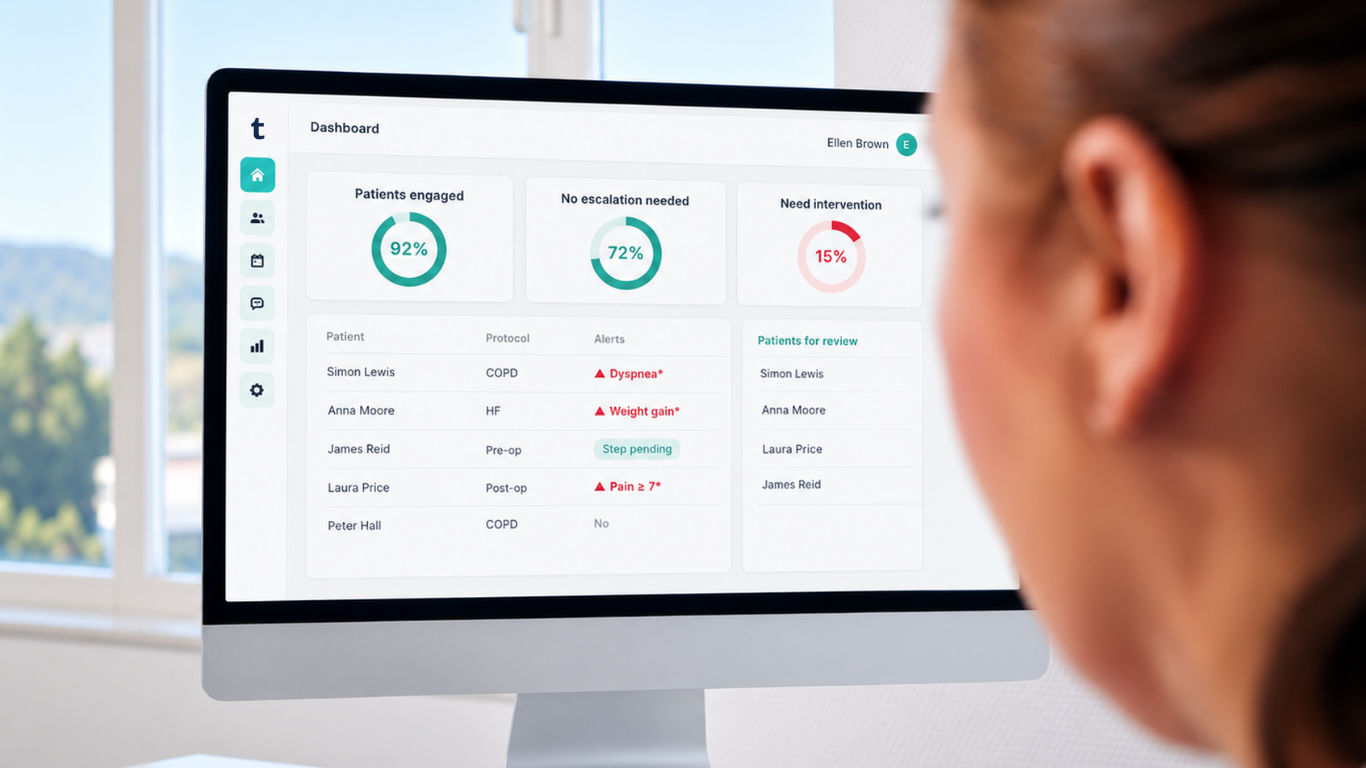
Healthcare professional checking the Tucuvi follow-up dashboard on screen
Continuity
Patients remain in follow-up throughout the programme or course of treatment.
Structured information
Symptoms, adherence, reported side effects, patient-reported outcomes (PROs) and experience, captured in a usable format.
Programme delivery
A defined protocol becomes a pathway with tasks, timings, rules and escalation.
Patient acceptance
A channel patients use naturally, with no app or prior digital registration, and an average satisfaction of 4.7/5 across Tucuvi programmes.
Care integration
Programme activity connects with clinical systems and existing care pathways where needed.
Healthcare professional in a consultation with a patient
Related solutions

Treatment does not happen in isolation

Administrative access

The check-ups that sustain treatment are scheduled, confirmed and rescheduled within the same contact.

Chronic care monitoring

When follow-up does not end with the course of treatment and the patient stays enrolled with no end date.

Post-discharge care

When the regimen starts at discharge and understanding needs to be confirmed before the first check-up.

The pathway, applied to your treatment programme

We will walk you through a programme like yours: the information collected at each contact, the responses that trigger an alert and how your team receives them.