SOLUTIONS
PHARMACY & MEDICATION MANAGEMENT

More capacity for your pharmacy. More support for your patients.

Tucuvi supports pharmacy conversations, from prescription refill and pickup coordination to medication adherence follow-up. Reach more patients, identify medication-related concerns, and connect those who need additional support with your pharmacy team.

+28% More prescriptions dispensed vs. baseline at Boston Medical Center
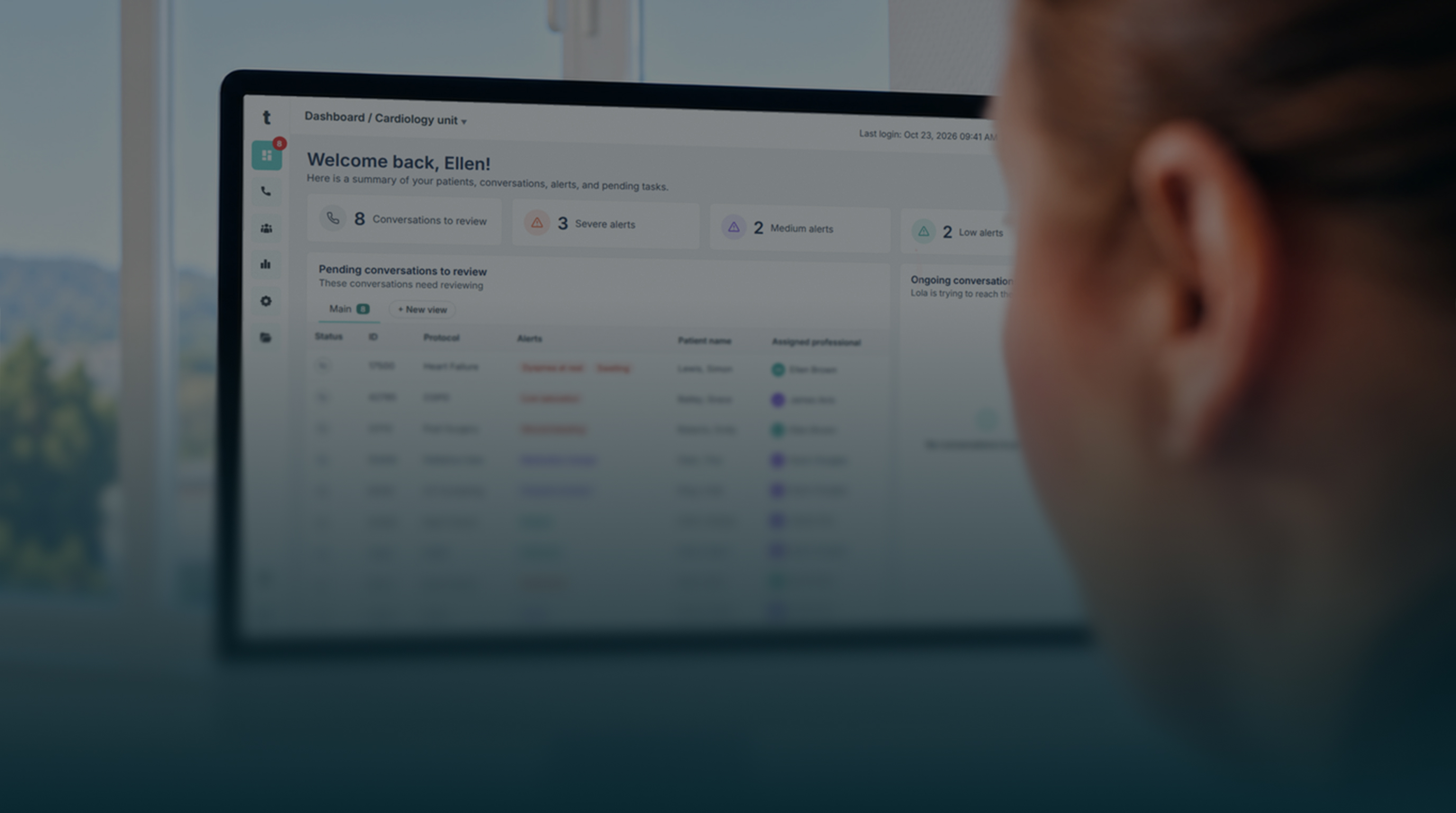
Healthcare professional reviewing a patient's follow-up on screen
SOLUTION

Support patients through their medication journey.

Extend your pharmacy’s reach and follow through on what patients need. Tucuvi handles routine conversations and medication-related follow-up, helping your team move prescription requests forward and address barriers to treatment.

Prescription refill outreach

Contact patients with prescriptions due for refill and confirm refill intent for each medication. Record full or partial confirmations and reasons for declined refills, so your pharmacy team can process confirmed requests and review those requiring follow-up.

Pickup and delivery coordination

Confirm medication pickup or delivery preferences and collect the details needed for fulfillment. Follow up on uncollected prescriptions to identify access barriers or logistical issues requiring pharmacy support.

Medication adherence follow-up

Assess patient-reported medication use against the prescribed regimen. Identify missed doses, treatment discontinuation, and adherence barriers requiring pharmacy follow-up.

Medication-related concerns and safety signals

Capture patient-reported side effects, dosing or administration questions, and concerns following medication changes. Flag cases for clinical review according to your pharmacy’s escalation criteria.

HOW IT WORKS: MEDICATION REFILL IN ACTION

From your refill list to an actionable patient response

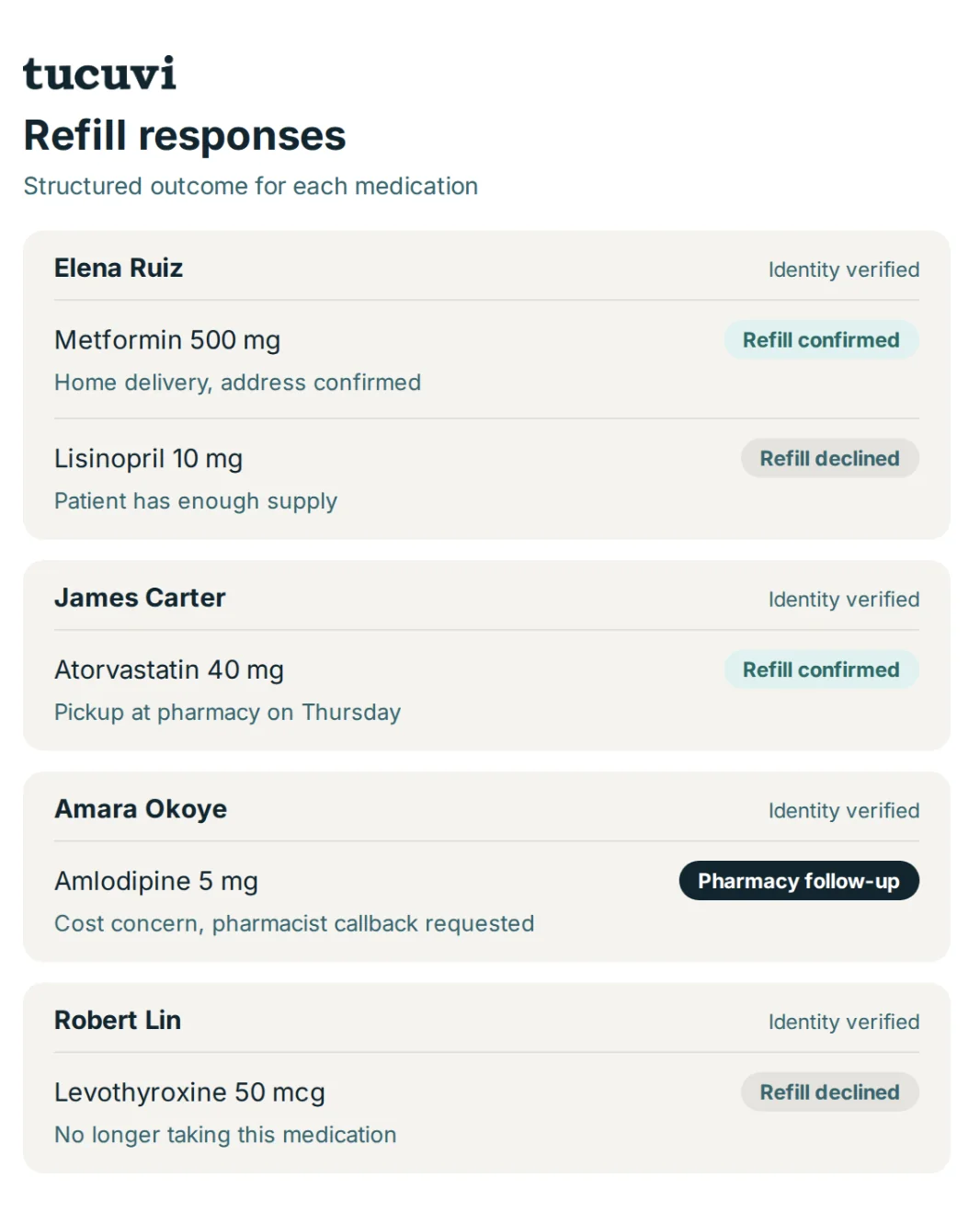
See how Tucuvi supports prescription refill outreach: confirming patient requests, capturing fulfillment preferences, and identifying when pharmacy follow-up is needed.

Tucuvi Health Manager showing a list of refill responses collected from patients
1. Define your refill workflow

Your pharmacy provides the eligible refill list and defines contact timing, conversation protocols, retry rules, and alert criteria.

2. Contact and verify the patient

Each call identifies your pharmacy and clearly introduces the AI agent. Patient identity is verified before medication details are discussed. Unanswered calls follow your configured voicemail and retry protocol.

3. Capture a response for each medication

Review each medication due for refill, confirm the patient’s request, and capture pickup or delivery preferences. Identify reasons for declining, medication questions, and urgent supply needs.

4. Process requests and coordinate follow-up

Your pharmacy team reviews refill requests in Tucuvi Health Manager, processes confirmed requests, and follows up on medication-related concerns or patient needs requiring pharmacy expertise.

REAL-WORLD EVIDENCE

Expanding refill outreach at Boston Medical Center

David Twitchell, Senior Vice President and Chief Innovation Officer at Boston Medical Center Health System
+80%
of nursing time freed up from post ambulatory surgery follow-up
Patients rarely stop their medication on purpose. More often, life gets in the way, the refill slips, and by the time anyone notices they have gone days without it. We wanted to reach those patients sooner, without taking our pharmacists away from the patients who need their expertise. Tucuvi worked alongside our team as a true partner, shaping the program with our pharmacists as it ran, and that is a big part of why it has worked.
David Twitchell, PharmD, MBA, Senior Vice President and Chief Innovation Officer
Boston Medical Center Health System
Success stories

Operational capacitypatient support and appointment management

A selection of the success stories of this solution.

Success study
Autonomous Appointment Rescheduling
77%
sustained autonomy on completed calls
See success story →
Success study
Reducing wheelchair referral-to-handover time
77%
Reduction in referral-to-equipment handover time for routine referrals
See success story →
BENEFITS

More capacity for your team. More value for your pharmacy.

Reach more patients, support prescription fulfillment, and coordinate pharmacy outreach across your network.

Reach more eligible patients

Reach more eligible patients without increasing routine calling demands on pharmacists and technicians. Give your team more capacity to resolve barriers and support patients who need their expertise.

Support the sustainability of pharmacy services

Increase the number of eligible prescriptions filled within your pharmacy network, contributing to savings that support patient care and pharmacy services.

Identify barriers to medication continuity

Capture patient-reported cost concerns, side effects, missed doses, and treatment questions. Flag needs for follow-up according to your pharmacy’s protocols.

Coordinate outreach across your pharmacy network

Support multiple pharmacy sites through a common platform, with protocols configured for each workflow and consistent processes for patient contact and escalation.

Wheelchair use assessment
Collects the information needed to prepare the wheelchair assessment and prioritise the waiting list.
Diagnostic imaging survey
Records patient feedback after a diagnostic imaging test.
Clinical laboratory satisfaction survey
Records patient feedback after a blood test or laboratory visit.
Patient satisfaction survey
Records the patient’s rating of the care received.
Inbound patient messages
Records the message the patient leaves and passes it on to the clinical team.
Appointment rescheduling
Manages appointment changes and confirms the new slot.
Appointment reminders and confirmation
Confirms attendance and records whether the patient wants to change or cancel the appointment.
Appointment booking
Books the appointment by matching available slots with the patient’s preferences.
Primary care demand management
Books appointments according to the patient’s reason for contact in primary care.
Missed vaccination appointment follow-up
Contacts patients who missed their vaccination appointment, records the reason and offers a new one.
Vaccination appointment booking
Contacts patients who accepted vaccination but have no appointment yet and books it in the same contact.
Vaccination campaign for at-risk patients
Contacts patients whose clinical situation calls for vaccination, offers the recommended vaccine and books the appointment.
Pneumococcal vaccination campaign
Invites the target population to get the pneumococcal vaccine, answers questions covered by the protocol and books the appointment.
Bowel cancer screening campaign
Invites the eligible population to bowel cancer screening and records their response.
Shingles vaccination campaign
Invites the target population to get the shingles vaccine, answers questions covered by the protocol and books the appointment.
Flu vaccination campaign
Invites the target population to get their flu vaccine and records their response.
Breast cancer screening campaign
Invites the eligible population to breast cancer screening and records their response.
Post-TAVI follow-up
Identifies signs of complications after transcatheter aortic valve implantation.
Follow-up after pacemaker or ICD implantation
Records the patient’s progress after pacemaker or implantable cardioverter-defibrillator implantation.
Pre-anaesthetic classification
Collects pre-anaesthetic information so the team can classify each patient.
Post-surgical sepsis detection
Records warning signs after surgery and generates an alert when they meet the team’s criteria.
Minor surgery follow-up
Records the patient’s progress after discharge from minor surgery.
Endoscopy preparation
Reminds patients of preparation steps and documentation for their endoscopy.
Day surgery follow-up
Contacts the patient at home after day surgery and records their recovery.
Pre-anaesthetic assessment
Collects pre-anaesthetic information for the anaesthesia team.
Pre-TAVI monitoring
Identifies signs of worsening that may support bringing forward transcatheter aortic valve implantation.
Pre-operative cardiovascular monitoring
Monitors the cardiovascular status of patients awaiting cardiovascular surgery.
Surgery preparation
Checks the patient’s health and reminds them of the documentation needed before surgery.
Wrist osteoarthritis follow-up after discharge
Assesses health status after hospital discharge in patients with wrist osteoarthritis.
Urinary tract infection symptom monitoring
Identifies signs and symptoms suggestive of a urinary tract infection.
Knee osteoarthritis follow-up after discharge
Assesses health status after hospital discharge in patients with knee osteoarthritis.
Postnatal follow-up
Contacts the patient after childbirth to record her recovery and answer questions.
Frailty follow-up after hospitalisation
Follow-up of patients with frailty after a hospital stay.
Follow-up after an A&E visit
Records the patient’s progress after an A&E visit and answers questions covered by the protocol.
Heart failure follow-up after discharge
Follow-up after discharge to identify signs of worsening and help prevent complications or readmissions in patients with heart failure.
Sleep apnoea: CPAP follow-up
Records symptoms, adherence and CPAP use in patients with sleep apnoea.
HCM symptom assessment (HCMSQ)
Records the patient’s symptoms during treatment using the HCMSQ questionnaire.
Malignant bowel obstruction follow-up
Follow-up of symptoms, medication and wellbeing in patients with ovarian cancer and malignant bowel obstruction.
Chronic lymphocytic leukaemia treatment follow-up
Identifies side effects of BTK inhibitor, BCL-2 inhibitor or anti-CD20 treatment in patients with CLL.
Prostate cancer follow-up
Follow-up of signs of progression, medication and wellbeing in patients with prostate cancer.
Medication adherence in heart failure with reduced ejection fraction
Assesses adherence to quadruple therapy and diuretic treatment in patients with heart failure with reduced ejection fraction.
End-stage kidney disease follow-up
Follow-up of patients with end-stage chronic kidney disease.
Type 2 diabetes follow-up
Follow-up of patients with type 2 diabetes.
Anxiety and depression assessment (Goldberg)
Records anxiety and depression symptoms using the Goldberg scale.
Emotional wellbeing follow-up
Regular follow-up of the patient’s emotional state.
Heart failure self-care assessment (EHFScBS)
Assesses self-care habits in patients with heart failure using the EHFScBS scale.
Quality of life assessment (EQ-5D-5L)
Measures health status and quality of life with the EQ-5D-5L questionnaire.
Pacemaker remote transmission support
Supports patients during pacemaker data transmission and records any incidents for the team.
Hospital-at-home follow-up
Follow-up of symptoms, medication and wellbeing in patients receiving hospital-at-home care.
Palliative care follow-up
Follow-up of symptoms, medication and wellbeing in patients receiving palliative care.
Systemic lupus erythematosus follow-up
Follow-up of symptoms, medication and wellbeing in patients with moderate to severe lupus.
Inflammatory bowel disease follow-up
Follow-up of symptoms, medication and wellbeing in patients with intestinal disease.
Advanced chronic kidney disease follow-up
Follow-up of symptoms suggesting progression in patients with advanced chronic kidney disease.
Severe asthma follow-up
Follow-up of symptoms, disease control, medication and wellbeing in patients with severe asthma.
Complex chronic patient follow-up
Follow-up of symptoms, medication and wellbeing in complex chronic patients, mainly with COPD and heart failure.
Heart failure follow-up
Regular follow-up to identify exacerbations or situations that need intervention in patients with heart failure.
Pharmacist walking through a hospital corridor
RELATED CAPABILITIES

Support patients across the wider care journey

Patient Access & Demand Management

Help patients reach the right team for medication-related questions and requests.

Chronic and Longitudinal Care Management

Support patients managing long-term conditions, with medication-related concerns flagged for follow-up.

Post-Discharge Care

Follow up after discharge to identify medication questions and connect patients with the support they need.

Give your pharmacy team more capacity to support patients

See how Tucuvi handles routine refill outreach and gives your team clear information to process requests and follow up.