Discover what an AI Care Management platform is and how it helps health systems scale clinical and operational AI workflows.

What is an AI Care Management platform?
An AI Care Management platform is clinical and operational infrastructure that automates and orchestrates care workflows for hospitals and health systems at population scale. It integrates with existing EHR and hospital operations systems rather than replacing them, and it is the place where a health system deploys, supervises, and scales the healthcare AI agents that run that work.
The category exists because the underlying need exists. Hospitals are running out of capacity, and patients wait too long, not only for care but to access it. Care teams and operations staff spend the majority of their day on the protocol-driven work that fills clinical and operational schedules.
This is not workflow automation, not a clinical chatbot, not a remote patient monitoring tool, and not a scheduling assistant. Those are point solutions that handle a slice of a workflow. An AI Care Management platform is the infrastructure that runs the workflow itself, clinical or operational, under one governance.
Three properties define an AI Care Management platform
- It automates and orchestrates care workflows end to end. Outreach, conversation, prioritization, escalation, human handoffs, and closed-loop documentation. The platform delivers prioritized, actionable information to the right team at every step.
- It deploys, supervises, and scales AI agents as a fleet. Clinical safety governance is built in as an operational system: protocol versioning, audit trail, monitoring, and incident management. The platform treats AI agents the way a hospital treats medical devices, not the way IT treats automations.
- It works across the entire care journey. Clinical and operational workflows, under one architecture and one audit trail. Phone-based voice is the inclusive surface for population scale, because voice reaches every patient regardless of age, digital literacy, or device access, and because every phone-based interaction can be recorded, audited, and reviewed under medical-grade governance.
What changes when clinical and administrative workflows run on one platform
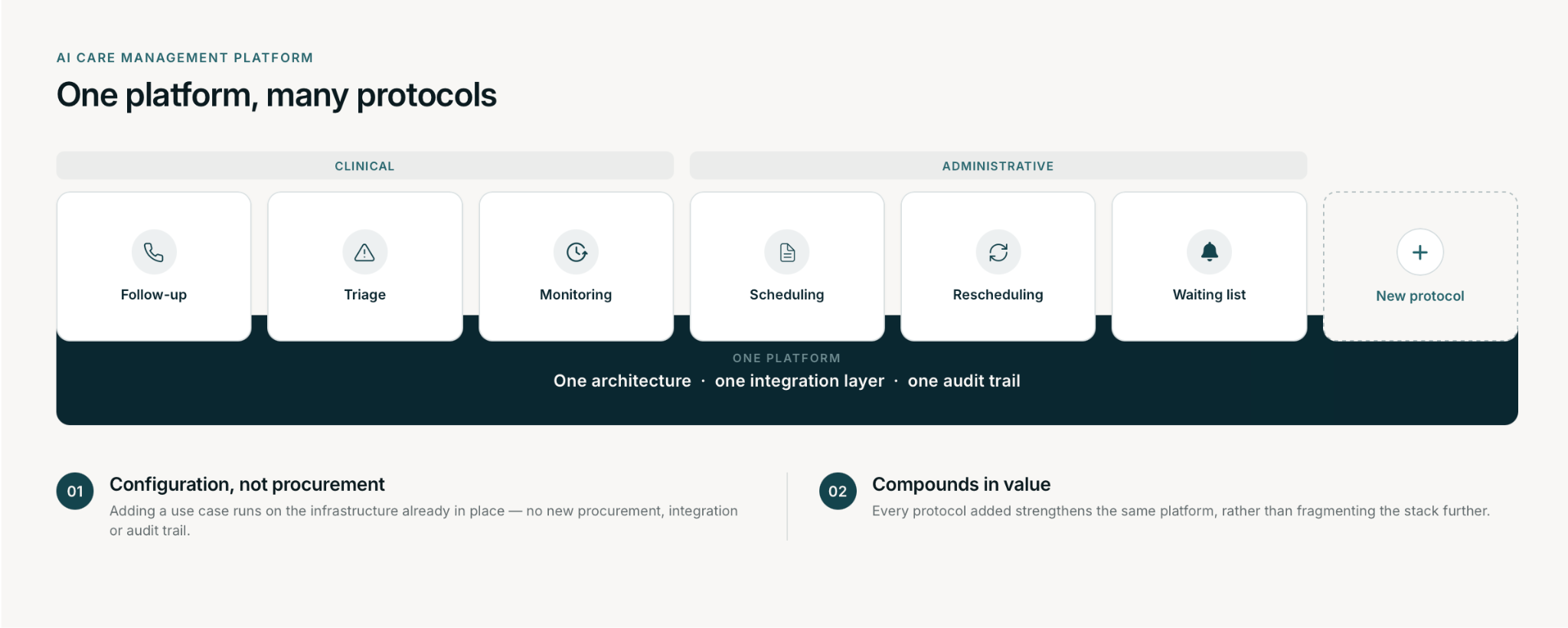
For years, healthcare AI has been planned along a dividing line that runs through every health system: clinical workflows on one side, operational on the other. Each side served by a different vendor, with different integrations, different audit trails. The result is a fragmented stack of point solutions, each scoped to a single workflow, each procured and governed independently. Every new use case becomes a new procurement, a new integration, a new audit trail.
Tucuvi as an agentic AI Care Management platform
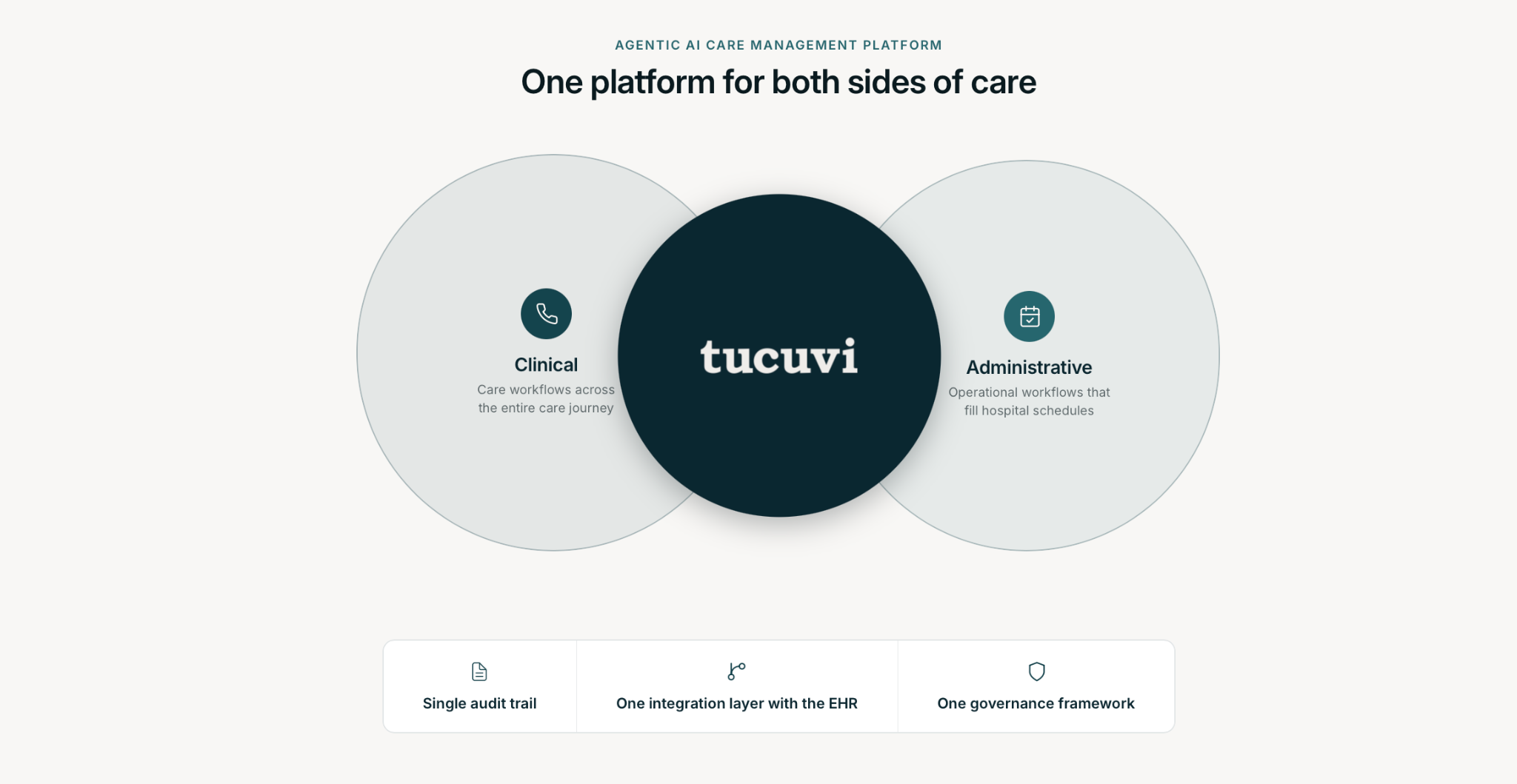
Tucuvi is an agentic AI Care Management platform built on exactly that principle. Within the Tucuvi platform, Tucuvi Health Manager (THM) is the underlying AI Care Management software that deploys, supervises, and scales AI agents across clinical and administrative workflows. LOLA is the clinical voice AI agent that runs inside the platform.
Tucuvi runs both clinical and administrative workflows on the same platform. On the administrative side, this includes inbound call handling, appointment scheduling and confirmation, mass rescheduling when clinic schedules change, and waiting list management.
Running both sides on one platform means a single audit trail, a single integration layer with the EHR and operational systems, and a single governance framework.
What to look for when evaluating an AI Care Management platform
Most platforms can demonstrate a convincing conversation. Far fewer can demonstrate the conditions that allow that conversation to run across hundreds of thousands of patients, safely, without scaling the workforce behind it. Three questions separate the two.
- Is it built to clinical-grade standards where the workflow demands it? A platform performing medical functions in patient pathways should be assessed under medical device regulation when applicable: MDR in Europe (Class IIb for higher-risk clinical software); FDA SaMD guidance in the United States. A platform without that standing should be evaluated as operational automation, not clinical infrastructure.
- Is every action traceable, across one conversation and across the population? Clinicians reviewing notes, operations leaders monitoring escalations, and external auditors performing regulatory review should all be able to see what the platform did, why, and what happened next, from inside the same system.
- Does it expand capacity under one governance, instead of adding tools under separate ones? The test is whether the next protocol, clinical or operational, runs on the same infrastructure already in place, or requires a new procurement, integration, and audit trail. A platform that answers yes can be deployed across an entire health system. A platform that cannot is a pilot waiting to expire.
The future of healthcare AI is not better individual tools. It is one platform running every clinical and operational workflow that protocol-driven work demands.
